easy1000words / Vietnamese guides / Sport
Pickleball in Vietnam
Find a game, book a court, call the score and pay your share: the Vietnamese you'll hear on pickleball courts in Saigon and Hanoi, all with audio.
- 70 phrases to hear
- 6 min read
- Updated November 22, 2026
Hear it firstTap a line to hear it
In short
Ask Chơi pickleball không? (want to play?), or in the South Đánh pick không? A planned game is a kèo, so Có kèo không? asks if there's a game on and Cho mình ghép kèo với asks to join one. On court, the kitchen is bếp, Ra ngoài! means out, and the score is called in Vietnamese numbers: Không, không, hai.
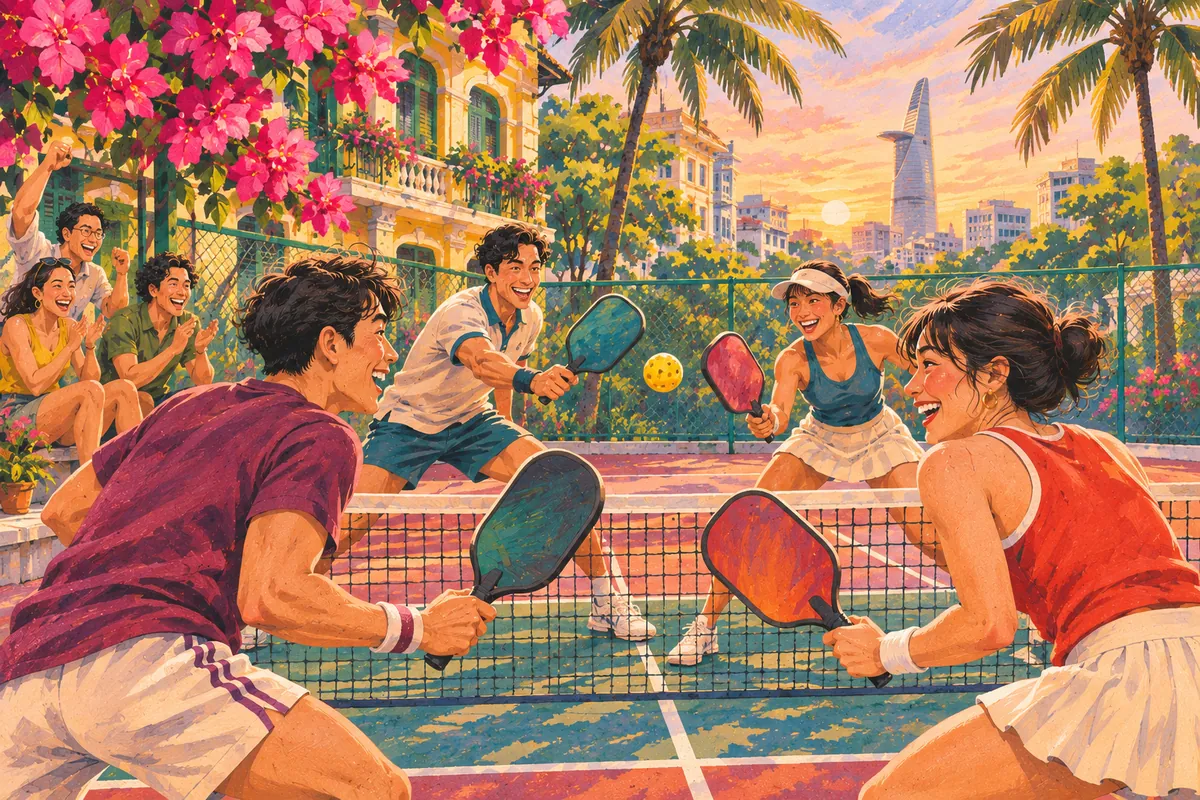
Pickleball has become one of the easiest ways to meet people in Vietnam's cities. Courts fill up from early morning to late at night, office teams book them after work, and every neighbourhood seems to have a Zalo group looking for a fourth player. If you play, you can walk onto almost any court and be in a game within the hour.
The game itself is the same everywhere, and players borrow plenty of English: dink, drive, lob, rally. The talk around it is pure Vietnamese, with its own slang for setting up a game, sharing a court and paying your share. This guide covers the phrases you'll hear from the first message to the coffee afterwards. Every line has audio, so you can hear how it really sounds before you say it, and the sports phrasebook in the app has 80 more for football, the gym and the big matches.
Finding a game: kèo, ghép kèo and booking a court
11 phrases
The key word is kèo. It started as betting slang for odds (more in our guide to Vietnamese slang), and now means any plan you make with friends: a coffee, a drink, a game. Có kèo không? is "anything on?", chốt kèo is "it's confirmed" and hủy kèo is "it's off". If a group is one player short, you ghép kèo: you join their game.
Courts are rented by the hour, and the players split the cost. Ask if a court is free, what an hour costs and whether you can rent a paddle if you didn't bring one. Southerners often shorten the sport to pick, and say đánh (hit) rather than chơi (play).
- Chơi pickleball không?Want to play pickleball?
- Đánh pick không?Want to play pick?Casual, very Southern.
- Có kèo không?Is there a game on?
- Chốt kèo nha!It's on, then!
- Hủy kèo rồi.The game's off.
- Cho mình ghép kèo với.Can I join your game?
- Còn thiếu người không?Are you short of a player?
- Sân còn trống không?Is the court free?
- Mình muốn đặt sân.I'd like to book a court.
- Một giờ bao nhiêu tiền?How much is it per hour?
- Có cho thuê vợt không?Do you rent paddles?
Practise “Pickleball: find a game” in the appfree
Tip Mình (I, me) is the friendly default between players your own age. It works with strangers on court too.
Your level and your partner
8 phrases
Before a game, people ask your trình, short for trình độ (level). Groups looking for players often post a number, such as trình 2.5 or trình 3.0, so the games stay even. If you're new, say so: nobody minds, and players will happily mix the pairs.
Most social games are doubles, đánh đôi. Your partner is the person you cặp with, and xoay cặp means rotating partners after each game, which is how open play usually works.
- Bạn trình mấy?What's your level?
- Mình mới chơi.I'm new to this.
- Mình chơi cũng tạm.I'm okay, not bad.Modest, the usual answer even from good players.
- Đánh đôi nha.Let's play doubles.
- Đánh đơn không?Want to play singles?
- Ai cặp với ai?Who's partnering who?
- Xoay cặp nha.Let's rotate partners.
- Mình cặp với bạn nha.I'll partner with you.
Serving and calling the score
8 phrases
The score is called the same way as in English, just in Vietnamese numbers: your team's score, the other team's score, then the server number. A game starts at không, không, hai (zero, zero, two). When the serve passes to the other side, someone calls Đổi giao!, the Vietnamese for side out.
The numbers you need most are một (1), hai (2), ba (3), bốn (4), năm (5), sáu (6), bảy (7), tám (8), chín (9), mười (10) and mười một (11). Our guide to Vietnamese numbers covers the tricky ones, like why 15 is mười lăm, not mười năm.
- Ai giao trước?Who serves first?
- Tới lượt bạn giao.Your serve.
- Giao đi!Serve!
- Không, không, hai.Zero, zero, two.How every doubles game starts.
- Ba, hai, một.Three, two, one.
- Điểm mấy rồi?What's the score?
- Đổi giao!Side out!
- Người thứ hai giao.Second server.
On the court: out, net and the kitchen
11 phrases
The non-volley zone is simply bếp, the kitchen, and a foot in it while volleying is a lỗi bếp. Line calls are short and loud: Ra ngoài! for out, Bóng trong! for in. A ball on the line is in, and people will remind you with Trúng vạch là trong nha.
For the shots, you'll hear English and Vietnamese side by side. A dink is bỏ nhỏ (drop it short) or just dink, and a smash is đập. In doubles, calling the ball saves arguments: Của bạn! (yours), Của mình! (mine).
- Ra ngoài!Out!
- Bóng trong!It's in!
- Trúng vạch là trong nha.On the line is in.
- Lưới!Net!
- Bạn đứng trong bếp!You're in the kitchen!
- Lỗi bếp!Kitchen fault!
- Bỏ nhỏ đi.Dink it.Bỏ nhỏ comes from badminton and tennis.
- Đánh chậm lại.Slow it down.
- Đập đi!Smash it!
- Của bạn!Yours!
- Của mình!Mine!
Cheering, and one more game
10 phrases
Vietnamese courts are noisy in a friendly way. A good shot gets Đẹp quá! or Hay quá!, and a near miss gets Tiếc quá! (what a shame). Social games usually go to eleven, won by two, and teams switch ends halfway.
When the game ends, someone always wants another. Phục thù không? is a playful "revenge match?", and Hôm nay vậy đủ rồi is how you say you're done for the day. Thank people as you leave: it's the easiest way to get invited back.
- Đẹp quá!Beautiful!
- Hay quá!Great shot!
- Tiếc quá!So close!
- Đổi sân nha.Let's switch ends.
- Ván này mười một điểm nha.This game is to eleven.
- Thêm một ván nữa không?One more game?
- Phục thù không?Rematch?
- Hôm nay vậy đủ rồi.That's enough for today.
- Chơi vui quá, cảm ơn nha!That was fun, thanks!
- Bạn đánh hay quá!You play really well!
Paddles, balls and shoes
7 phrases
A paddle is a vợt, the same word as a tennis or badminton racket. The ball is bóng in the North and banh in the South, and both are understood everywhere. Paddles are a favourite topic, so expect questions about yours, and expect to hear chính hãng (genuine), since copies are common.
Bring water and proper court shoes. Outdoor courts get very hot by mid-morning, which is why so many games start at 5 or 6 am.
- vợtpaddle
- Vợt mới hả? Đẹp quá!New paddle? It looks great!
- banhball (South)North: bóng.
- giàyshoes
- Mang nước theo nha.Bring some water.
- Bạn mua vợt ở đâu vậy?Where did you buy your paddle?
- Cái này chính hãng không?Is this the genuine one?
After the game: coffee, Zalo and paying up
8 phrases
Games are organised in Zalo groups, Vietnam's main messaging app, so expect to swap Zalo rather than phone numbers. Someone posts the court and time, players reply to join, and the organiser chốt danh sách (closes the list).
Paying is quick: the court fee is split and sent by bank transfer, usually by scanning a QR code. Prices are said in thousands of đồng, and năm chục (five tens) means 50,000. Then it's coffee, đi cà phê, which is where the real friendships start.
- Cho mình xin Zalo nha.Can I get your Zalo?
- Vào nhóm Zalo nha.Join the Zalo group.
- Chốt danh sách nha.Let's close the list.
- Ai chưa đóng tiền sân?Who hasn't paid for the court?
- Mình chuyển khoản rồi.I've sent it by transfer.
- Mỗi người năm chục.Fifty thousand each.
- Quét mã nha.Scan the code.
- Đi cà phê không?Coffee?
Warm-ups, cramps and sore legs
7 phrases
Pickleball looks gentle, but quick stops and long rallies catch people out. Warm up first, stretch after, and know how to say where it hurts. Mệt muốn xỉu (so tired I could faint) is the standard exaggeration after a long morning session, and you'll hear it a lot.
- Khởi động trước nha.Warm up first.
- Giãn cơ đi.Stretch it out.
- Bị chuột rút rồi!I've got a cramp!
- Mình bị trặc chân.I've twisted my ankle.
- Chườm đá đi.Put some ice on it.
- Đau cơ quá.My muscles are so sore.
- Mệt muốn xỉu.I'm dead tired.
Questions
What is pickleball called in Vietnamese?
Pickleball, with a Vietnamese accent. In the South it's often shortened to pick, as in đánh pick. There's no separate Vietnamese name, and the main shots keep their English names too: dink, drive, lob.
Do you say chơi or đánh pickleball?
Both are right. Chơi means play and works for any game. Đánh means hit, and Vietnamese uses it for racket sports: đánh tennis, đánh cầu lông (badminton), đánh pickleball. Football takes đá (kick) instead.
What does kèo mean?
A plan or a game with friends. It began as betting slang for odds, and now covers anything you arrange: có kèo (there's a game on), chốt kèo (confirmed), hủy kèo (cancelled), ghép kèo (join someone else's game). It's casual, so use it with friends and fellow players, not in an email to your boss.
How do you call the score in Vietnamese?
Exactly like in English, with Vietnamese numbers: serving team's score, receiving team's score, server number. Không, không, hai starts a doubles game. Many mixed groups call it in English, so either is fine.
Is it easy to join a game as a foreigner?
Usually, yes. Ask the people on a court, or ask for the local Zalo group. A few words of Vietnamese, even just Cho mình ghép kèo với, go a long way, and you'll be invited back much faster.